If you corner an astrophysicist at a party and ask them what happened 13.8 billion years ago, they will talk your ear off.
They can walk you through the first three minutes of creation with absurd confidence. They will tell you when the first quarks glued themselves into protons, the exact microsecond when light decoupled from matter to paint the Cosmic Microwave Background, and how hydrogen pooled into the very first stars.
We have the receipts. We have satellite maps of the infant universe taken when it was barely 380,000 years old.
Then you ask the obvious follow-up question:
“Okay, cool. What was happening five minutes before that?”
Suddenly, the room gets very quiet.
The dirty little secret of modern cosmology is that our neat story of the universe has a giant black bar slapped across page one. Human brains are wired for cause and effect: a match strikes, a flame appears; a clock ticks, time moves forward. It feels deeply unnatural, even borderline insulting, to be told that reality simply started ticking out of nowhere.
So what was actually there? Did nothingness suddenly decide to explode? Or were other universes already churning away in the dark?
Here is what modern physics actually says when you strip away the sanitized textbook answers.
The Big Bang Wasn't an Explosion in Empty Space
First, we need to unlearn the cartoon version of the Big Bang that most of us were taught in school.
When people picture the Big Bang, they usually imagine a pitch-black, empty room. In the middle of that room sits an impossibly tiny, glowing dot. Suddenly, the dot blows up, spraying matter out into the darkness.
That picture is completely wrong.
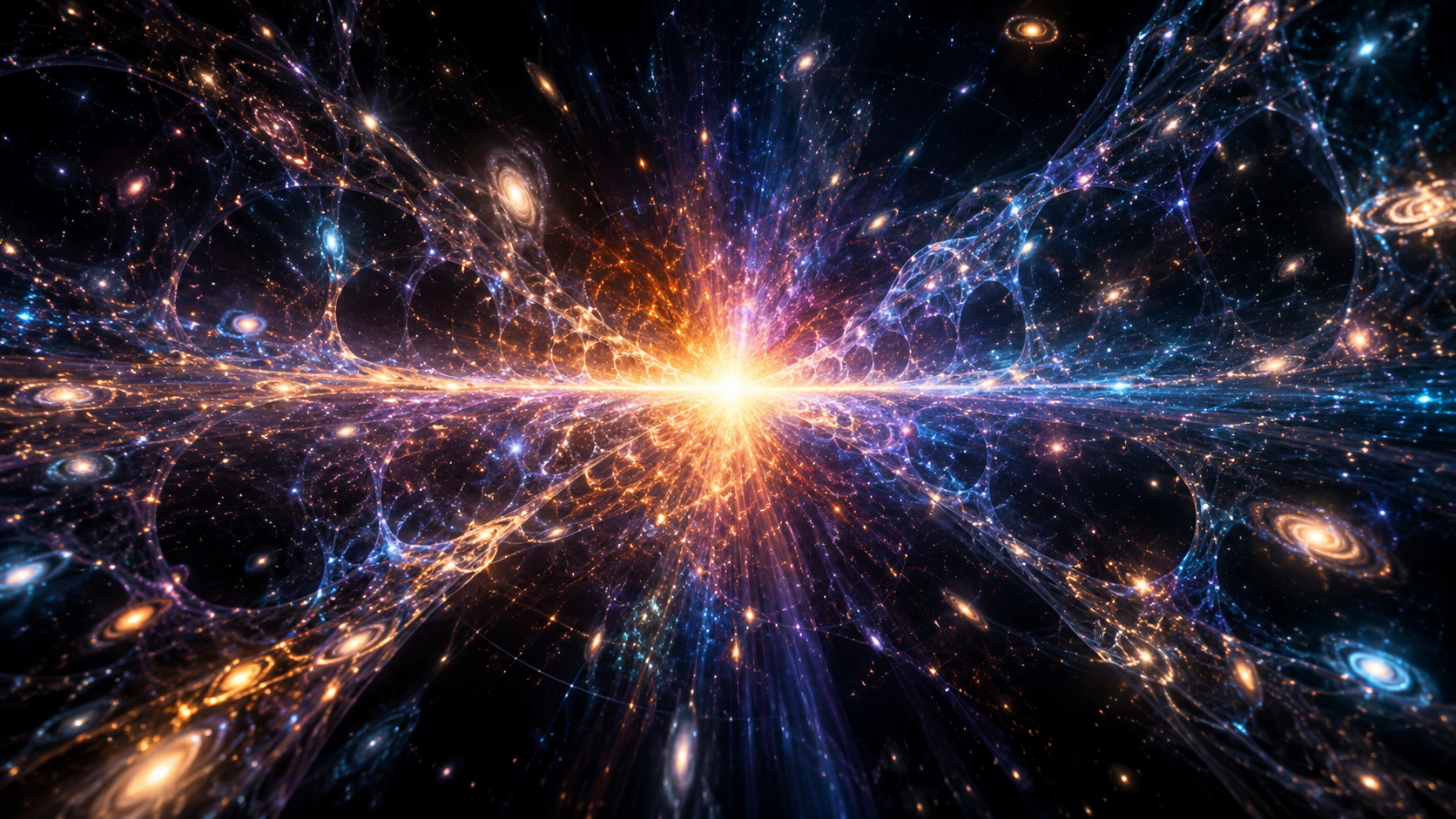
There was no room. There was no outside void waiting to be filled. The Big Bang was not an explosion of matter into space; it was an expansion of space itself. Every single place that exists today (the space between your eyes, the core of the Sun, the most distant galaxy visible to the James Webb Space Telescope) was crammed into that initial micro-state.
When you hit rewind on the universe, you are not watching galaxies pull back toward a center point. You are watching the grid lines of spacetime shrink.
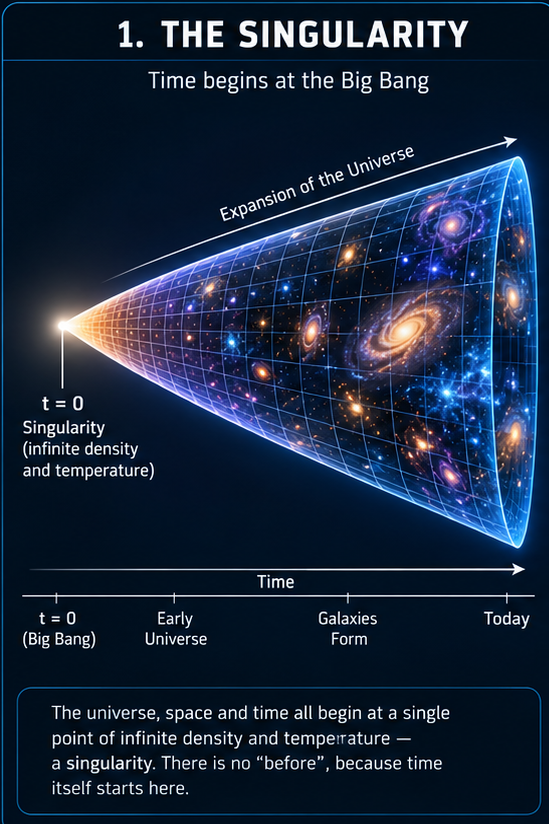
1. The Classical Answer: The Math Just Crashed
If you follow Albert Einstein’s General Relativity strictly by the book, you run into a terrifying dead end: the gravitational singularity.
As you rewind the clock toward $t = 0$:
Density goes up.
Temperature spikes into trillions of degrees.
Gravity becomes infinitely strong.
The volume of the universe reaches zero.
In physics, "infinity" is not a real measurement you can read off an instrument. When infinity pops up in a physics equation, it is nature’s way of saying: Your model has broken down. You don’t know what you are talking about.
Under pure General Relativity, space and time are physically bound together into a single fabric. If you crush that fabric down to zero size, the dimension of time does not just stop running; it ceases to exist as a concept.
Stephen Hawking famously answered the "what came before" question with his own puzzle: What is north of the North Pole?
Stand at the very top of the globe, look in any direction, and every step you take is south. North has not been blocked by a brick wall. The geometry of the sphere simply does not accommodate a point further north. Under this classical view, asking what happened before the Big Bang is a broken sentence. Time started at $t = 0$, end of story.
Except almost no working cosmologist today believes that is the whole truth.
2. The Inflationary Multiverse: Our Universe Was Just a Bubble in Boiling Water
The classical singularity relies on Einstein’s math, but Einstein’s math completely ignores quantum mechanics, the physics of the ultra-small. And when the universe was smaller than a grain of pollen, quantum mechanics was running the show.
In the 1980s, physicists like Alan Guth and Andrei Linde realized something crucial: before the hot, dense soup of matter and light existed, space was dominated by an intensely energetic vacuum field. This sparked a period called Cosmic Inflation.
For a fraction of a second, space expanded exponentially, expanding faster than light and stretching out any cosmic wrinkles into a flat, smooth canvas.
When inflation eventually slowed down in our region, that pent-up vacuum energy decayed into particles, radiation, and heat. That "reheating" event is what we traditionally call the Big Bang.
Here is where it gets wild: quantum physics says inflation does not stop everywhere at once.
Think of a pot of boiling water. In some spots, bubbles form. Inside our bubble, inflation stopped, the energy condensed into matter, and our local universe began expanding normally. But outside our bubble, the background spacetime is still inflating at hyper-speed, constantly calving off brand-new, isolated pocket universes.
If this theory, known as Eternal Inflation, is correct, what existed before our Big Bang?
A vast, restless, self-reproducing multiverse that has likely been inflating forever. Our Big Bang was not the birth of everything. It was just the moment our local bubble cooled off.
3. The Big Bounce: The Universe Hit a Floor
There is another camp of physicists, mostly working on Loop Quantum Gravity, who tackle the problem by asking: Can space actually be cut into infinitely small pieces?
General relativity treats space like smooth, seamless silk. But Loop Quantum Gravity suggests that space is more like a piece of fabric woven from discrete, indivisible threads. There is a fundamental "pixel" of reality called the Planck length, roughly $10^{-35}$ meters. You cannot have a volume of space smaller than that.
Why does that matter? Because it puts a hard ceiling on density.
If space has pixels, you can never pack an entire universe down into a point of literal zero volume. When a collapsing universe reaches that maximum quantum threshold (the Planck density), gravity flips. The quantum geometry pushes back with an overwhelming repulsive force.
Instead of crashing into a dead-end singularity, the collapsing universe reaches a minimum size, rebounds, and blows outward into a fresh expansion.
Under this model, known as the Big Bounce, the Big Bang was not a beginning at all. It was an inflection point. Before our universe expanded, an older universe was collapsing under its own gravity. Our cosmos might simply be one breath in an endless cycle of cosmic inhalation and exhalation.
4. Roger Penrose’s Crazy Idea: An Infinity That Forgets Its Size
Perhaps the most poetic, mathematically radical idea comes from Nobel laureate Sir Roger Penrose, called Conformal Cyclic Cosmology (CCC).
Fast forward into our own unimaginable future:
In about $10^{14}$ years, all stars burn out.
In $10^{40}$ years, even protons may decay.
In $10^{100}$ years, the last supermassive black holes quietly evaporate via Hawking radiation.
What is left? A universe containing literally nothing but massless photons and gravitons drifting across a dead, cold void.
Here is the catch: massless particles do not experience time. If you travel at the speed of light, relativity dictates that time stands completely still. Without mass, there is also no way to measure physical scale. An expanding universe that is $10^{100}$ light-years across looks mathematically identical to a microscopic point if there are no clocks or rulers left inside it to tell the difference.
Penrose showed that when a dying universe loses all concept of scale and time, its geometry smoothly resets. The infinitely diluted, cold graveyard of an old universe becomes the pristine, low-entropy starting condition for the Big Bang of the next one.
Each cycle is called an "Aeon." What was there before our Big Bang? The frozen, timeless ghost of the previous universe.
The Reality of Where We Stand
Right now, nobody can hand you an ironclad laboratory proof of what happened before $13.8$ billion years ago. We are standing on the shore of a cosmic ocean, peering as far into the fog as the light of the early universe allows us to see.
To crack this open completely, we need a working theory of Quantum Gravity, a single mathematical language that can handle both the titanic weight of gravity and the slippery quantum behavior of subatomic particles. Until those two branches of physics stop fighting each other, the true $t = 0$ remains locked.
Did time have a hard starting line?
Are we an offshoot bubble in a hyper-inflating foam?
Or are we living in the ashes of an ancestor universe that died to give us birth?
Whichever answer turns out to be true, one thing is certain: the universe did not start with an empty room and a quiet countdown. Reality is far stranger, far older, and far more stubborn than that.