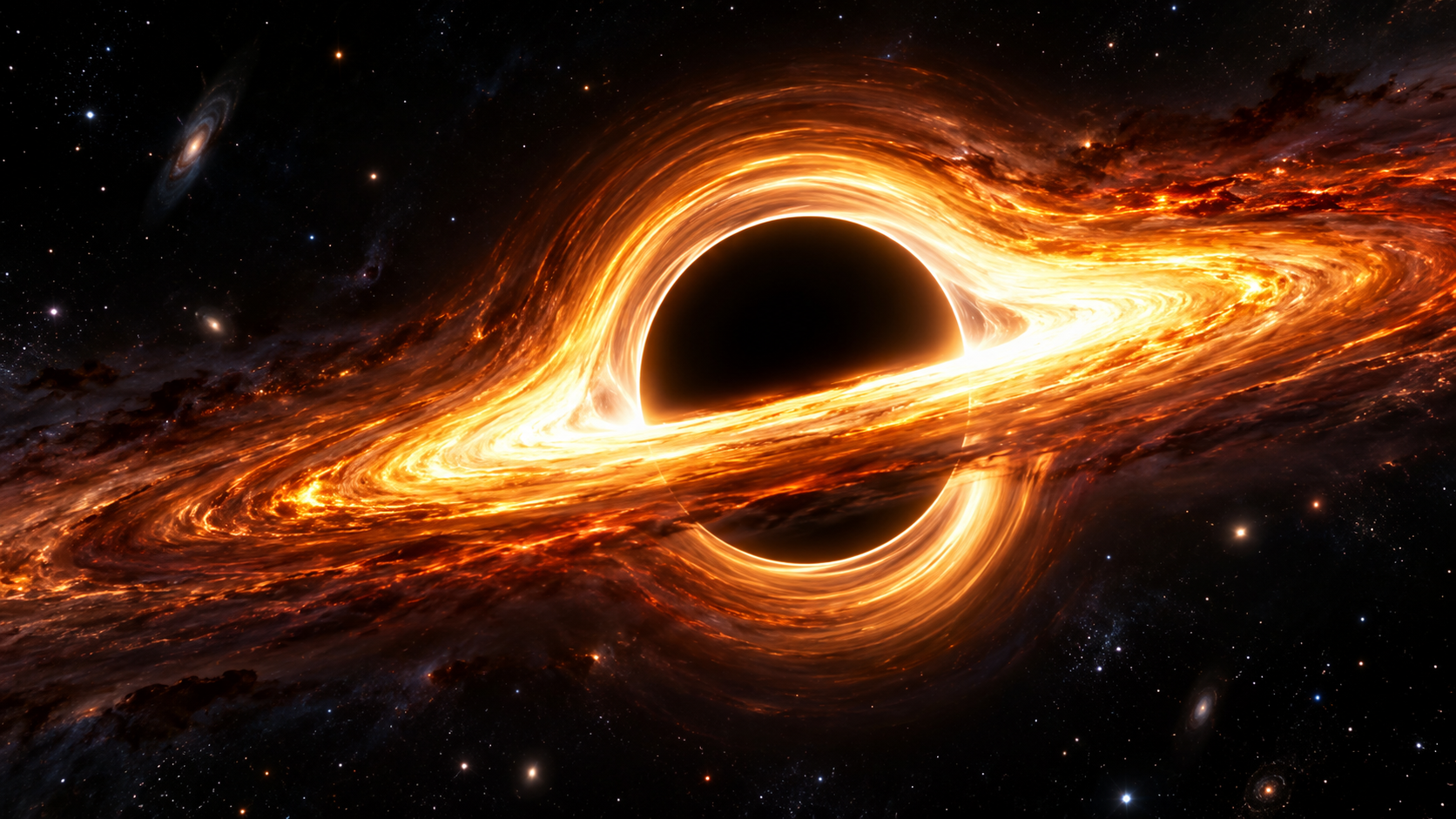
Most people assume black holes are a special species of cosmic monster, born only from exotic, dying supergiant stars.
That is only half true.
In pure physics, a black hole is not defined by what it is made of. It is defined entirely by geometry and density. In fact, every single physical object you can touch could technically become a black hole: your phone, your car, Mount Everest, or the entire planet Earth.
All you have to do is squeeze that mass down past a very specific mathematical threshold.
That boundary is governed by one of the most famous equations in astrophysics. If you have ever searched for the formula for black hole physics, here is the exact math, the bizarre story behind it, and what happens when you plug real numbers into it.
The Master Equation: The Schwarzschild Radius
The foundational formula for a black hole calculates its "event horizon," the invisible point of no return where escape velocity equals the speed of light.
It is called the Schwarzschild radius formula:
At first glance, it looks intimidating. But when you break it down, it only relies on three core variables:
(Schwarzschild Radius): The radius of the black hole's event horizon in meters.
(Gravitational Constant): Newton’s universal constant of gravity ().
(Mass): The total mass of the object you want to turn into a black hole (in kilograms).
(Speed of Light): The universal speed limit ().
Notice what is missing here: there is no variable for temperature, chemical composition, or atomic structure. The formula does not care whether the mass comes from iron, hydrogen gas, or cheese. The only thing that determines the size of a black hole is its mass ().
Everything else in the equation (, , and ) is just a set of fixed, unchanging numbers.
The Story Behind the Math
The wild part about this equation is where it came from.
In late 1915, Albert Einstein published his groundbreaking General Theory of Relativity. His field equations were notoriously complex systems of non-linear differential equations. Einstein himself believed exact solutions might take decades to find, or might only ever be approximated.
Just months later, a German physicist and astronomer named Karl Schwarzschild calculated the first exact solution.
He did not do it in a quiet university office. Schwarzschild was serving on the Russian front during World War I, doing ballistic calculations for the German army while suffering from a painful autoimmune disease. Between artillery barrages, he solved Einstein’s equations for a single, non-rotating sphere of mass.
Schwarzschild sent his paper to Einstein in January 1916. Einstein was stunned by the mathematical elegance, but he fundamentally rejected the real-world implication. Einstein was convinced that nature would have guardrails to prevent an object from ever collapsing all the way down to that critical radius.
Schwarzschild died just months later from his illness at age 42, never knowing that telescopes a century later would photograph the exact shadows his wartime math predicted.
What Happens When You Plug in Real Objects?
Because the formula for a black hole only depends on mass, we can run simple thought experiments with everyday things.
1. What if you turned the Earth into a black hole?
Earth has a mass of roughly kilograms. Its current radius is about 6,371 kilometers.
If you feed Earth's mass into the equation:
That is approximately 8.8 millimeters, or about a third of an inch.
If you could take all six sextillion metric tons of Earth (every mountain, ocean, building, and person) and crush it down into a sphere the size of a marble or a small peanut, Earth’s gravity would overpower every known force in physics. The escape velocity at its surface would exceed the speed of light, and our planet would vanish into a black hole.
2. What about the Sun?
Our Sun has a diameter of roughly 1.4 million kilometers. If you plug its mass ( kg) into the formula, you get:
To turn the Sun into a black hole, you would have to compress its entire volume into a sphere less than 3 kilometers across, roughly the size of a small town.
(Side note: Even if the Sun suddenly became a 3-kilometer black hole right now, Earth would not get sucked in. Because the total mass would stay identical, our orbit wouldn't change at all. We would just freeze in the dark.)
3. What about a 70 kg human?
Plug a 70-kilogram person into the formula, and the critical radius works out to roughly meters. That is billions of times smaller than a single proton. At that scale, quantum mechanics completely overrules classical gravity.
The Other Formula: Stephen Hawking’s Equation
When people look up the formula for a black hole, they often stumble upon a second, equally famous equation: the Bekenstein-Hawking entropy formula.
For decades, physicists thought black holes were pure cosmic trash cans: once matter went in, it vanished forever, violating the second law of thermodynamics. In the 1970s, Stephen Hawking and Jacob Bekenstein solved this paradox by demonstrating that black holes actually possess entropy and emit a faint, cold glow of thermal radiation (Hawking radiation).
Hawking was so proud of this discovery that he asked for the formula to be carved into his memorial stone at Westminster Abbey:
Where:
is the entropy of the black hole.
is the surface area of the event horizon.
is Boltzmann’s constant.
is the reduced Planck constant.
This formula united four completely separate branches of physics for the very first time: thermodynamics (), relativity ( and ), geometry (), and quantum mechanics ().
It revealed something profound: the total information content of a black hole is not proportional to its 3D volume, but to the 2D surface area of its event horizon. This single realization gave birth to the Holographic Principle, the idea that our three-dimensional reality might be an encoded projection from a distant two-dimensional boundary.
The Takeaway
A black hole is not a vacuum cleaner prowling the galaxy, waiting to swallow innocent star systems. It is simply mass that has lost its internal fight against gravity.
Schwarzschild’s equation tells us where that battle is permanently lost. It is a deceptively modest line of high school algebra that reveals the sharpest edge in our universe: the boundary where space and time switch places, and where no light can ever find its way back home.