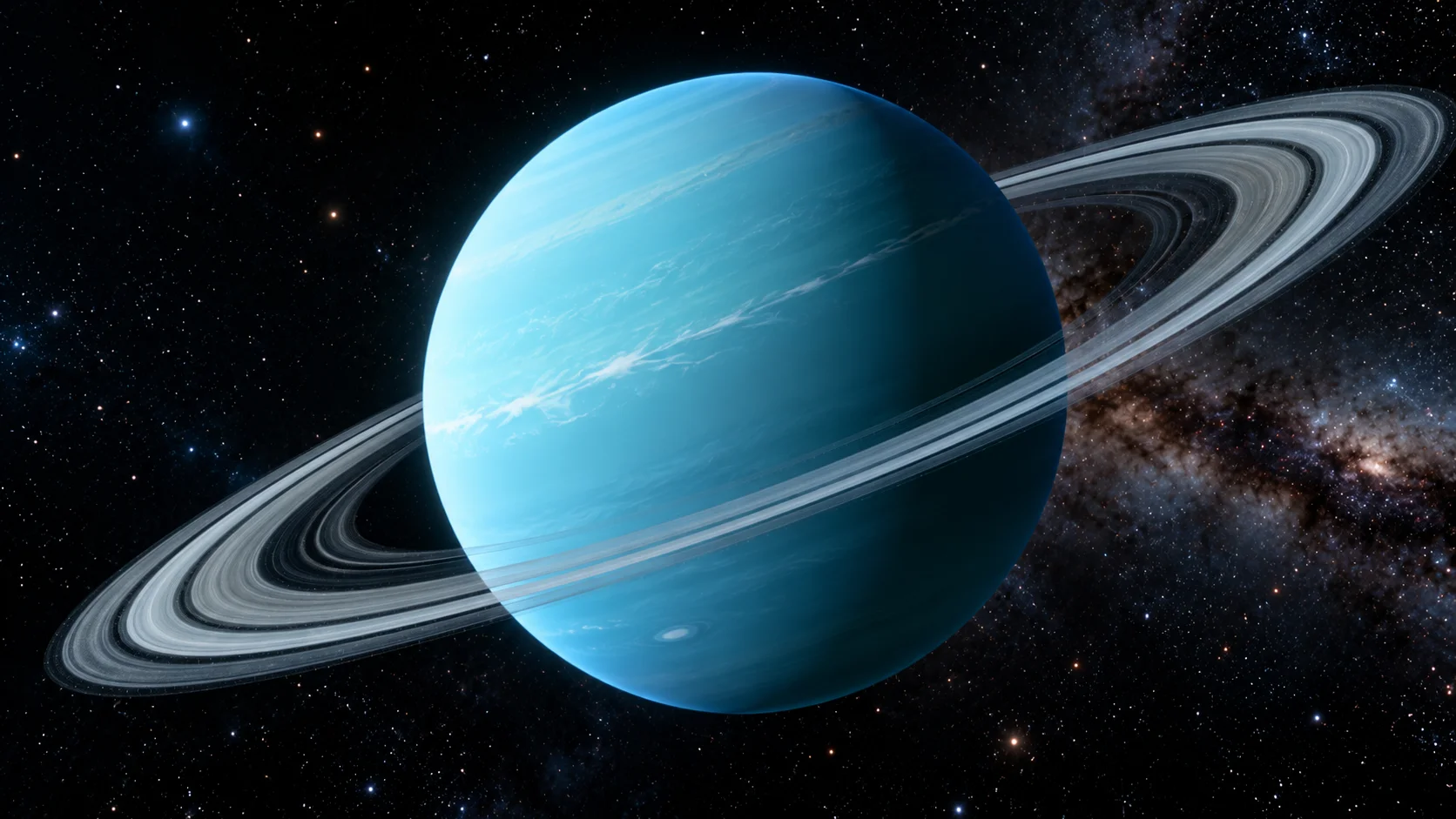
Uranus has spent decades as the punchline of our Solar System. Because of an awkward English pronunciation, generations of schoolkids were introduced to the seventh planet through juvenile giggles rather than genuine curiosity.
That is an absolute shame, because once you strip away the middle-school jokes, Uranus turns out to be one of the most violent, baffling, and physically broken worlds in our cosmic neighborhood.
It is an ice giant that rotates completely on its side, radiates virtually zero internal heat, and smells faintly of rotten eggs. Humanity has only flown past it a single time, back when NASA’s Voyager 2 swung by in January 1986. Everything else we know comes from the squinting eyes of space telescopes.
If you are looking for an honest, comprehensive uranus fact file, here is everything modern astronomy knows about the blue-green misfit of the outer Solar System.
When Uranus Was Discovered (and the Ridiculous Name It Almost Got)
For thousands of years, humanity thought Saturn was the boundary of the planetary system. Every ancient civilization could see Mercury, Venus, Mars, Jupiter, and Saturn because they were bright enough to spot with the naked eye.
That changed on March 13, 1781.
A German-born British astronomer named William Herschel was surveying the night sky from his garden in Bath, England, using a homemade seven-foot reflecting telescope. He spotted a faint, pale disk that moved slowly against the background stars. At first, Herschel thought he had found a new comet or an unusual star. After months of orbital calculations, astronomers realized the truth: Herschel had found the first planet discovered with a telescope in recorded human history.
That answers when uranus was discovered, but it immediately created a diplomatic feud over what to name it.
Herschel, grateful for royal patronage, wanted to name the planet Georgium Sidus (George’s Star) in honor of King George III of England. Unsurprisingly, astronomers outside of Britain were not thrilled about having a planet named after a sitting British monarch.
French astronomers briefly campaigned to simply name the planet "Herschel."
Eventually, German astronomer Johann Elert Bode stepped in with a logical compromise that settled why uranus is called uranus.
Bode argued that planetary names should follow classical mythology. Jupiter was the king of the gods, and Saturn was Jupiter’s father. Therefore, the planet beyond Saturn should be named after Saturn’s father: Ouranos, the ancient Greek primordial deity of the sky.
To this day, Uranus remains the only planet in our Solar System named directly after Greek mythology rather than Roman lore (the Roman equivalent would have been Caelus).
How Far Is Uranus from the Sun and Earth?
Because Uranus orbits out in the cold twilight of the Solar System, the distances involved are hard to wrap your head around.
To understand how far uranus from the sun actually sits, look at the scale of astronomical units. Earth sits at 1 AU (about 150 million kilometers). Uranus sits at an average distance of roughly 2.87 billion kilometers (1.78 billion miles), or roughly 19.2 AU.
To put that in perspective, the sunlight warming your face right now took 8 minutes and 20 seconds to reach Earth. That exact same beam of light has to travel for another two hours and forty minutes before it reaches the upper cloud tops of Uranus.
Because both Earth and Uranus travel on elliptical paths around the Sun, the answer to how far uranus from earth is constantly shifting:
At its closest approach (opposition, when Earth sits directly between Uranus and the Sun), the planet is roughly 2.6 billion kilometers (1.6 billion miles) away.
At its furthest point (conjunction, when the Sun is directly between Earth and Uranus), the distance stretches to 3.15 billion kilometers (1.96 billion miles).
If you sent a high-speed radio transmission from Earth to an astronaut floating near Uranus, you would have to wait nearly six hours just to hear their reply.
What Uranus Is Made Of: It Is Not a Gas Giant
Pop-science books often lump Uranus and Neptune in with Jupiter and Saturn under the blanket term "gas giants." Modern planetary scientists do not. Uranus belongs to an entirely separate class of planet: the ice giant.
So, what uranus made of?
If you peel the planet like an onion, here is what you find:
The Outer Atmosphere: The cloud layer is roughly 83% hydrogen, 15% helium, and 2% methane. That trace amount of methane is responsible for the planet's tranquil, aquamarine color. Methane absorbs the red wavelengths of incoming sunlight and reflects the blue and green spectrum back into space. It also contains hydrogen sulfide, which means the upper clouds literally smell like rotten eggs.
The Slushy Mantle: Beneath the outer clouds, there is no solid surface to walk on. Instead, temperatures and pressures rise until the gas transitions into a dense, super-compressed, boiling-hot fluid composed of water, ammonia, and methane ices. (In planetary science, "ice" refers to any volatile chemical with a freezing point above roughly 100 Kelvin, even when it exists as a scorching supercritical fluid under extreme pressure).
The Core: At the absolute center sits a small, dense core of iron, nickel, and silicate rock, roughly the size of planet Earth.
Deep within that slushy mantle, something extraordinary happens. High temperatures (thousands of degrees) combined with crushing pressures (millions of times Earth's atmospheric pressure) can shatter methane molecules, splitting the carbon from the hydrogen. Scientists believe the liberated carbon atoms crystallize into literal diamonds, raining downward through the slush toward the rocky core.
The Cataclysm: Why Does Uranus Roll on Its Side?
Every other planet in our Solar System spins roughly upright like a spinning top. Earth is tilted at 23.5 degrees, giving us our seasons. Mars sits at 25 degrees. Saturn tilts at 27 degrees.
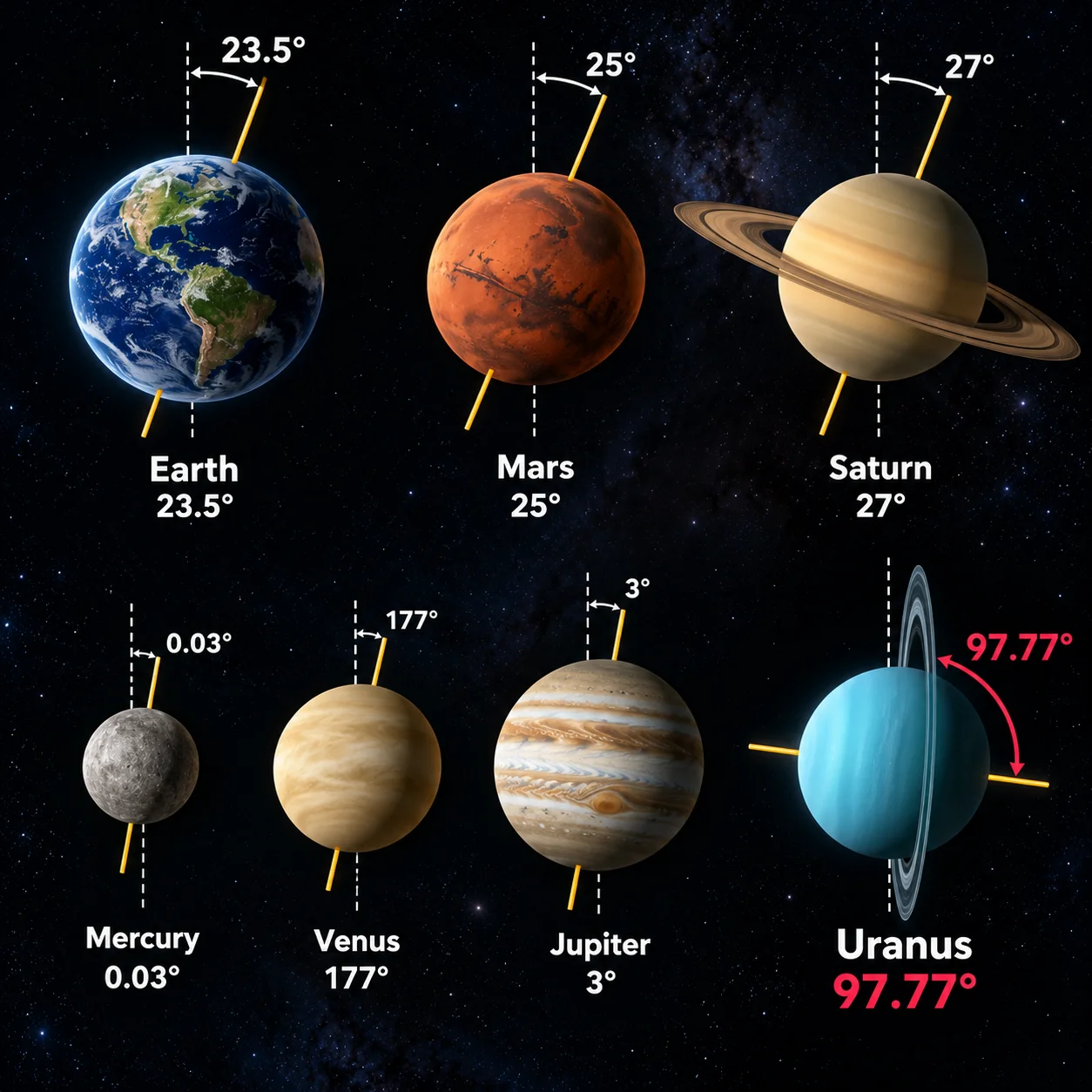
Uranus has an axial tilt of 97.77 degrees.
It is essentially knocked completely over on its side, rolling around the Sun like a cosmic bowling ball.
Because of this sideways tilt, Uranus experiences the most extreme seasons in the Solar System. It takes 84 Earth years to complete one orbit around the Sun. For 42 years at a time, one pole points almost directly at the Sun, basking in continuous, unbroken daylight. Meanwhile, the other half of the planet is locked in 42 years of freezing, uninterrupted night.
How does a planet end up like this?
Astronomers believe that around 4 billion years ago, during the chaotic early days of planetary formation, a rogue protoplanet roughly one to three times the mass of Earth slammed into Uranus at high velocity. The glancing impact did not obliterate the planet, but it knocked it over permanently, scrambled its interior, and threw up a halo of debris that eventually formed its faint ring system and inner moons.
The Mystery of the Coldest World
There is one final puzzle that continues to stump astrophysicists.
By all rights, Neptune should be colder than Uranus because Neptune sits another billion miles further from the Sun. Yet Uranus holds the record for the lowest temperature ever measured in the Solar System: a bone-chilling -224°C (-371°F).
Planets like Jupiter, Saturn, and Neptune still radiate more heat into space than they receive from the Sun, powered by leftover thermal energy from their formation. Uranus does not. Its internal heat flow is practically zero.
Whatever massive collision tipped Uranus on its side might have also stirred its core or capped its mantle, trapping its ancient internal heat deep inside or venting it all out into the void billions of years ago.
Uranus is not an empty, boring cue ball. It is an enduring cosmic crime scene, an icy laboratory of broken physics waiting for a dedicated spacecraft to finally go back and uncover the rest of the story.